
Out history
In 1881, Captain Thomas and Mrs Adelaide Sutherland officially brought The Salvation Army to Australia.
Since then, we’ve grown to a movement encompassing more than 30,000 officers, employees and volunteers who reach hundreds of thousands of Australians every year. Internationally, we offer programs and services in more than 130 countries — bringing hope, assistance and compassion to the people who need it most.
English beginnings
The Salvation Army's beginnings date back to 2 July 1865 when a Methodist minister — William Booth — commenced a work in East London that would encircle the world before the end of the 19th century. It began as the Christian Revival Society and soon after was called the East London Christian Mission.
Booth preached the Gospel to the poor and underprivileged and, by 1867, it had developed into a ministry offering basic schooling, reading rooms, penny banks, soup kitchens, and relief aid to the destitute.

The good word
The ministry spread to places outside of London.
The organisation grew rapidly and became known simply as the Christian Mission, with William Booth as its General-Superintendent.
The Salvation Army is born
In 1878 came another name change. William Booth was perusing a printer's proof, which referred to the Christian Mission as a 'volunteer army'. Booth swept his pen through the word 'volunteer' and changed it to read 'Salvation Army'. The name was adopted. Elijah Cadman, an enthusiastic believer, excitedly proclaimed in a meeting soon after, "God bless the Captains of The Salvation Army! I should like to wear a suit of clothes that would let everybody know I meant war to the teeth and salvation to the world."
A simple form of uniform was gradually adopted by its members. This, in 1880, was developed into a regulated uniform system. The full-time ordained ministers of the organisation were known as officers and adopted military rank titles according to seniority. The part-time ordinary members were called soldiers. Instead of General-Superintendent, William Booth became The Salvation Army's General; this remains the title given to the international leader of The Salvation Army. The mission-stations (churches) were henceforth entitled corps.
Booth's wife, Catherine, was a brilliant preacher and played a leading role in determining The Salvation Army's direction and doctrines — she became known as The Army's Mother. From the beginning, Catherine Booth firmly established equality for women to be ordained ministers of the Gospel and to hold leadership positions within The Salvation Army. She wrote a pamphlet in 1859, Female Ministry (pdf), which was truly ahead of her time. It gave biblical reasons as to why women can have an equal ministry with men.
After responding to a call from America in early 1880, The Salvation Army next answered calls to commence operations in Australia.
Gaining a foothold in Australia
Several localities lay claim to having held the first Salvationist meetings in Australia. These pioneering meetings were conducted by various immigrants who had been converted by The Salvation Army back in Britain. It is a meeting in Adelaide, however, that had the most impact on the growth of The Salvation Army in Australia.

Adelaide
Botanic Park
John Gore and Edward Saunders were both converts of the early Christian Mission.
They met unexpectedly in the colony of South Australia and, on 5 September 1880, led a meeting in the name of The Salvation Army from the back of a greengrocer's cart in Adelaide's Botanic Park.
In a climate where religion had failed to really gain acceptance...
Saunders, a railway worker, and Gore, a builder, presented themselves as ordinary men who simply wanted others to experience the salvation they had found. They held an ‘open air’ meeting, which concluded with a parting invitation from Gore that reflected Booth’s philosophical bent towards Christian ministry: "If there is any man here who hasn't had a decent meal today, let him come home to tea with me."
He was expressing the ethos of a Christian organisation which, from its earliest days, was concerned for a person's physical as well as spiritual needs. Little did he realise that, 140 years later, The Salvation Army would be serving millions of meals to Australians each year.
Saunders and Gore formed themselves into a Salvation Army corps (church) under Gore's temporary leadership and, not long after, William Booth signed the order for Captain Thomas and Mrs Adelaide Sutherland to be appointed to Australia. Thus, the official commencement of The Salvation Army in Australia was marked as 5 January 1881.
The Sutherlands were dispatched on the S.S. Aconcagua, arriving at Adelaide in February 1881. The new officers arrived wearing the first Salvation Army uniforms seen in Australia. Thomas wore a scarlet jacket (ex-British Army), navy-blue trousers, and a spike-topped white helmet, and Adelaide wore a princess robe-style dress with a small bonnet. They brought with them 12 uniforms and were met by 68 converts and Army followers.
Within three years, 32 officers were commissioned and 12 corps formed. On the third anniversary, 3600 soldiers mustered for the grand celebrations.
In 1882, Major James Barker and his wife Alice were appointed by the General and sent from London to extend and establish The Salvation Army's work "in all the colonies of the Southern Seas".
Intending to disembark at the Port of Adelaide, a wharf strike forced the Barkers on to Williamstown, Victoria. Friends of The Salvation Army met them and took them into Melbourne, where the Barkers were so impressed by the potential of Victoria that they determined to begin work there.
A growing influence in Australia
From its humble beginnings, The Salvation Army grew rapidly in Australia — with mixed reactions, at first. Salvation Army members often faced rowdy and sometimes violent opposition, with at least two members being mortally wounded. However, by 1890, mob attacks had virtually ceased, and by the early 1900s, Salvationists were accepted in the community.
The Salvation Army spread throughout Australia and New Zealand under the banner of the Australasian Territory until 1912, when New Zealand became a single territory. As The Salvation Army continued to expand its operations, and with limited communication methods at the time, Australia was split into two territories in 1921.
The Australia Eastern Territory managed Queensland, New South Wales and the Australian Capital Territory. In 1956, The Salvation Army Australia Eastern Territory helped commence work in Papua New Guinea — until 1994 when the country became an independent command. The Australia Southern Territory comprised South Australia, Tasmania, Victoria, Western Australia and the Northern Territory.
A national presence for The Salvation Army in Australia
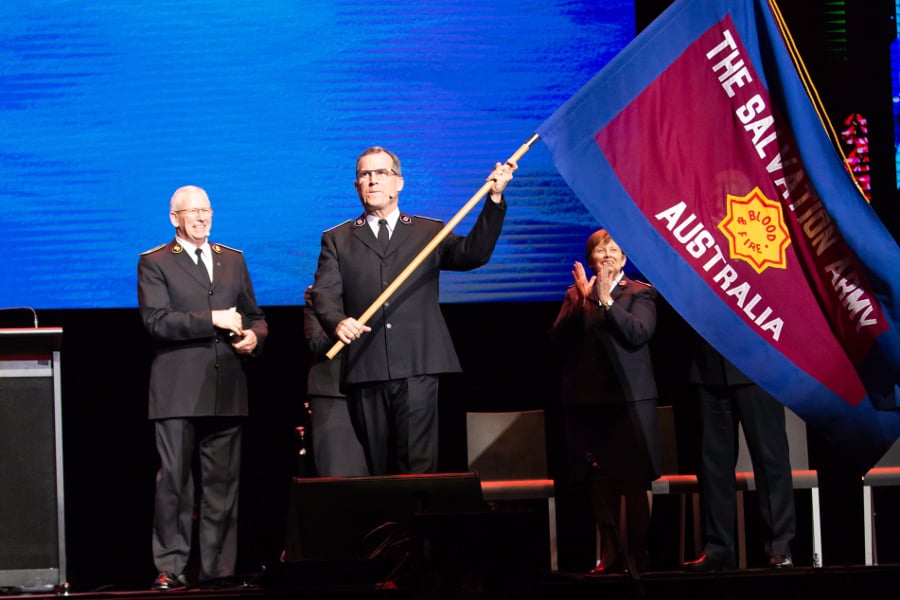
In March 2016, the world leader of The Salvation Army, General André Cox, announced that the two Australian territories would amalgamate. A journey of transition began called ‘Australia One’. On 1 December 2018, The Salvation Army in Australia became one national territory.
The leaders of this national territory were Commissioners Floyd and Tracey Tidd. They arrived in 2013 from their home country, Canada, initially appointed as territorial leaders for the then-Australia Southern Territory. When the national territory officially launched, they became Australia’s territorial leaders.
As one national territory, The Salvation Army became better positioned to have a greater collective impact. An aligned national mission and vision was launched to meet the needs of vulnerable Australians; create Christian faith pathways with innovative ministry opportunities; build stronger partnerships across government, community and corporate sectors; have a united voice on social justice; and increase capacity for innovation.
Nearly a decade on from the announcement, The Salvation Army Australia is still deeply committed to its vision of, “Wherever there is hardship or injustice, Salvos will live, love and fight, alongside others, to transform Australia one life at a time with the love of Jesus.”

History of our social work
From assisting discharged prisoners at the prison gates back in 1883 through to the network of life-changing social services we run today — our Australian story is one of empowering individuals and strengthening communities.

Serving the armed forces
The Salvation Army has shown an interest in the Armed Forces since its earliest days in England.

Notable Salvos
Many individuals have played an important role in shaping the culture, values and impact of The Salvation Army in Australia. These are just a few biographies.

How did the Red Shield Appeal start?
In 1965 the first trial Red Shield Appeal Doorknock was conducted in Sydney. It is now The Salvation Army’s largest community fundraiser, supporting our social services and outreach programs across Australia.

Historical Society
Learn helpful historical insights from The Salvation Army Historical Society. You might even like to go along for a tour.
Our faith
An Australian journalist once described the rapid spread of The Salvation Army in its early days as ‘like a bushfire’. What started under a gum tree with two ordinary men, without any theological training or qualifications, grew deep roots.
Today, The Salvation Army has over 300 established corps (churches) across Australia that work hand-in-hand with our communities and social services to transform the lives of those in need and spread the message of the love of Jesus.
Interesting facts...
Our faith
